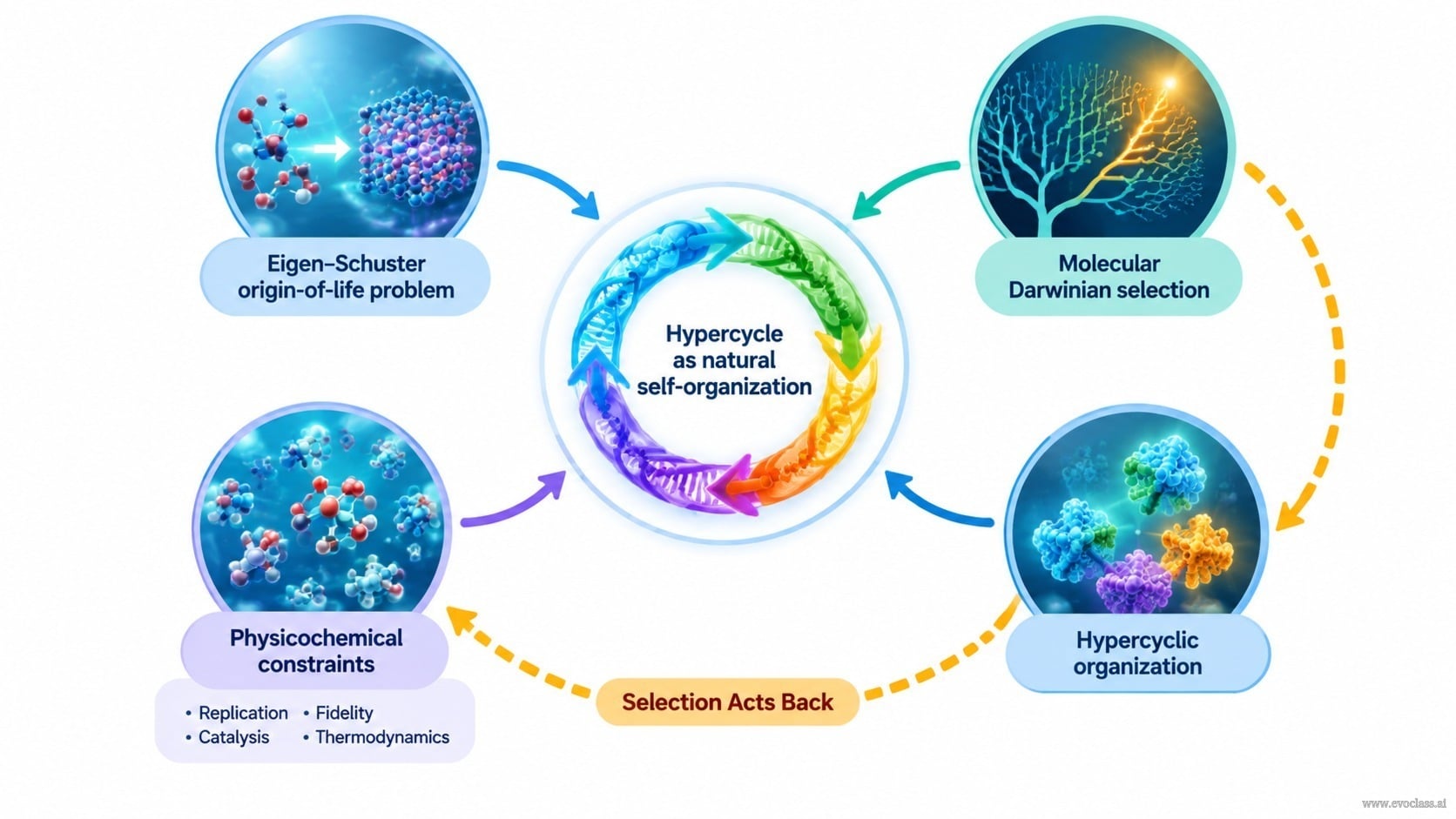
Eigen and Schuster's hypercycle is not an externally imposed design but a candidate principle of natural self-organization. The origin of life is reframed as a molecular problem: populations of replicating molecules must spontaneously achieve ordered reproduction, functional coupling, and selection. Whether they do depends on measurable physicochemical properties—replication kinetics, copying fidelity, catalytic interactions, thermodynamic stability, and mutation rates.
This framing makes molecular Darwinian selection an emergent outcome, not an a priori assumption. Heritable variation, differential replication, and permissive conditions for copying and catalysis are required. The central challenge is to achieve sufficient copying fidelity and functional integration to avoid error catastrophe and become selectable evolutionary units.
Hypercyclic organization is the higher-order self-organizing solution that links molecular replication to collective evolution. The three central theses introduced here can be summarized as: (i) life's origin is a problem of molecular self-organization; (ii) Darwinian selection arises only under specific kinetic and physicochemical constraints; (iii) persistent evolvable collectives require hypercyclic coupling that integrates self-replicators and overcomes error-threshold limits.
Example progression: self-replicating molecules → catalytic interactions among replicators → selection within a molecular population → self-organized hypercyclic coupling → collective Darwinian evolution.
Core Concepts
- Natural self-organization: The hypercycle is a candidate principle, not an externally designed mechanism. Ordered reproduction and functional coupling must emerge from interacting molecules.
- Origin-of-life problem: Eigen and Schuster frame life's origin as molecular self-organization: how populations of replicating molecules form ordered, persistent, evolvable collectives without an external organizer.
- Molecular Darwinian selection: Requires heritable variation, differential replication, and physicochemical conditions permitting copying and catalysis.
- Error threshold and copying fidelity: Finite fidelity limits the information a single replicative unit can maintain; integration is required to avoid degeneration.
- Hypercyclic organization: The higher-order solution linking molecular replication to collective evolution; detailed reaction structure and the three central theses are developed in subsequent slides.
Hypercycle Self-Organization Map
The central node represents the hypercycle as a principle of natural self-organization. Branches show the Eigen–Schuster origin-of-life problem, molecular Darwinian selection, physicochemical constraints (replication, fidelity, catalysis, thermodynamics), and hypercyclic organization; a dashed feedback arrow indicates selection acting back on molecular properties.